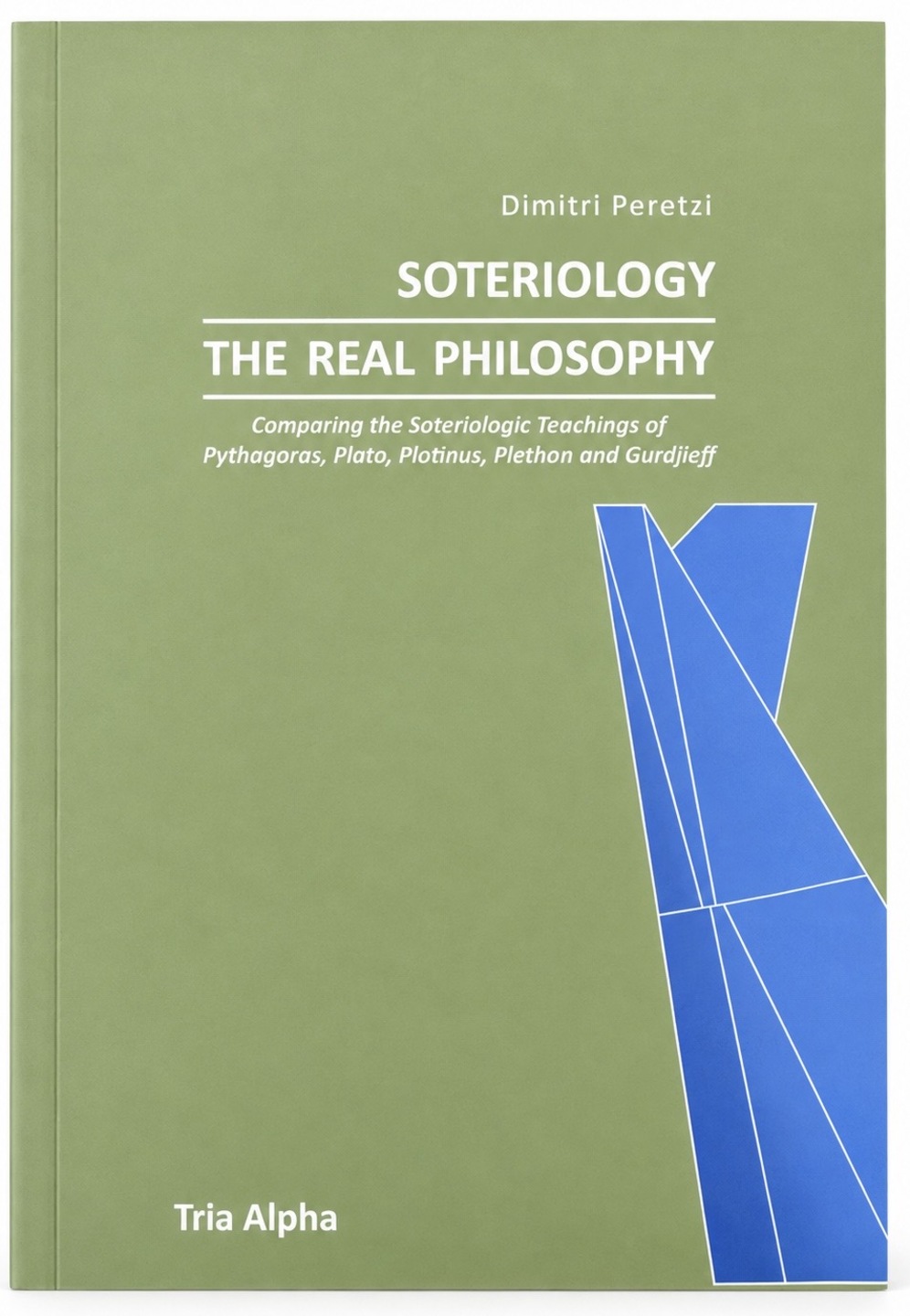
Soteriology the Real Philosophy
Comparing the Soteriologic Teachings of Pythagoras, Plato, Plotinus, Plethon and Gurdjieff
- Category
- Books
- Code
- B037
- Author
- Dimitris Peretzis
| ISBN | 978-960-99708-2-2 |
| Publisher | 3 ALPHA |
| Date of Publication | 2026 |
| Language | English |
| Number of pages | 313 |
| Dimensions | 21cm x 14cm |
| Cover | Soft cover |
Description
English Edition
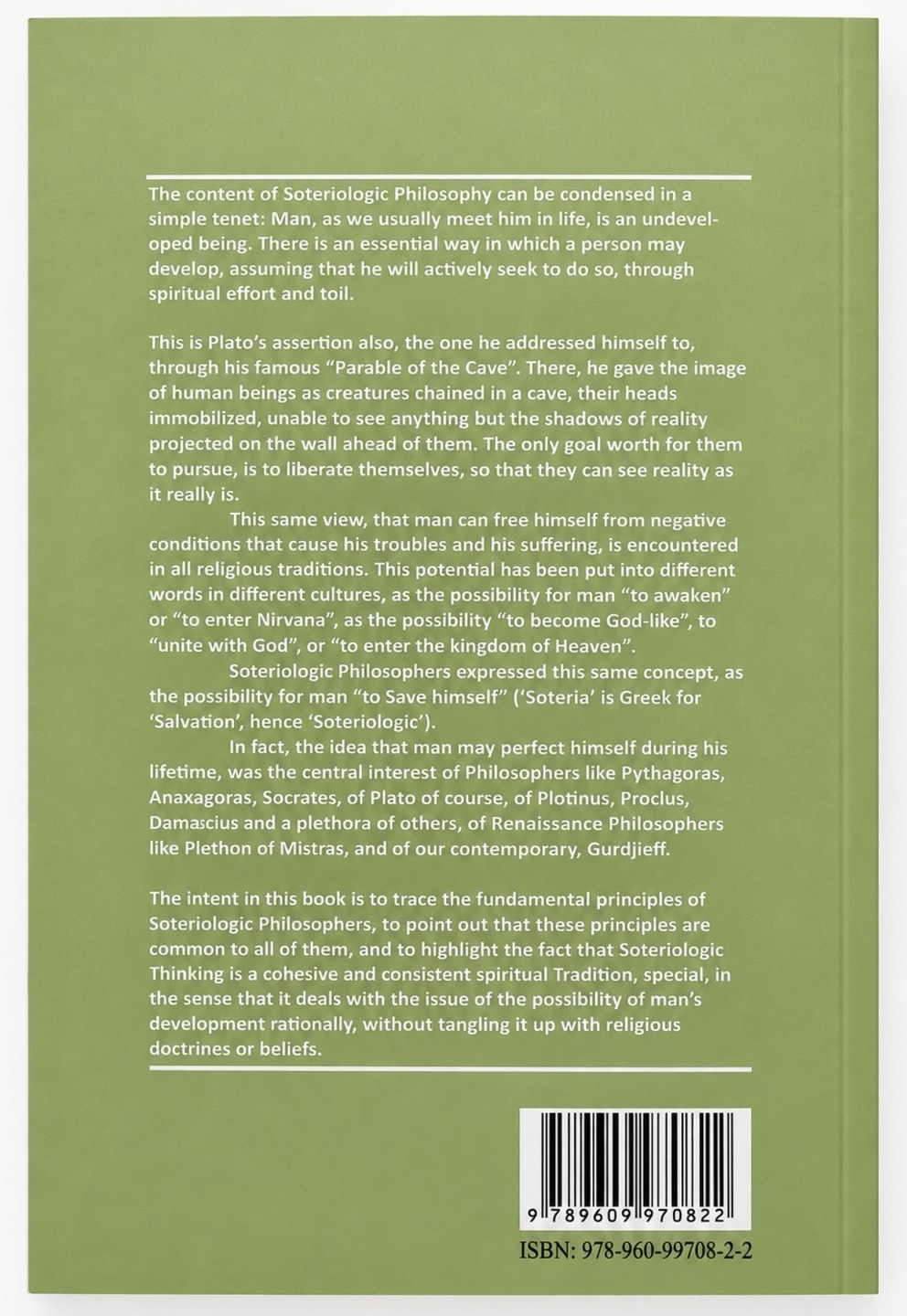
The content of Soteriologic Philosophy can be condensed in a
simple tenet: Man, as we usually meet him in life, is an undevel-
oped being. There is an essential way in which a person may
develop, assuming that he will actively seek to do so, through
spiritual effort and toil.
This is Plato’s assertion also, the one he addressed himself to,
through his famous “Parable of the Cave”. There, he gave the image
of human beings as creatures chained in a cave, their heads
immobilized, unable to see anything but the shadows of reality
projected on the wall ahead of them. The only goal worth for them
to pursue, is to liberate themselves, so that they can see reality as
it really is.
This same view, that man can free himself from negative
conditions that cause his troubles and his suffering, is encountered
in all religious traditions. This potential has been put into different
words in different cultures, as the possibility for man “to awaken”
or “to enter Nirvana”, as the possibility “to become God-like”, to
“unite with God”, or “to enter the kingdom of Heaven”.
Soteriologic Philosophers expressed this same concept, as
the possibility for man “to Save himself” (‘Soteria’ is Greek for
‘Salvation’, hence ‘Soteriologic’).
In fact, the idea that man may perfect himself during his
lifetime, was the central interest of Philosophers like Pythagoras,
Anaxagoras, Socrates, of Plato of course, of Plotinus, Proclus,
Damascius and a plethora of others, of Renaissance Philosophers
like Plethon of Mistras, and of our contemporary, Gurdjieff.
The intent in this book is to trace the fundamental principles of
Soteriologic Philosophers, to point out that these principles are
common to all of them, and to highlight the fact that Soteriologic
Thinking is a cohesive and consistent spiritual Tradition, special, in
the sense that it deals with the issue of the possibility of man’s
development rationally, without tangling it up with religious
doctrines or beliefs.
(from the back cover of the book)